Lore Guide
Why Jason Couldn't Keep the Gold Ranger Powers
Zeo gives Jason a compatibility problem, not a failure of courage. Follow the transfer, the warning and the return to Trey.
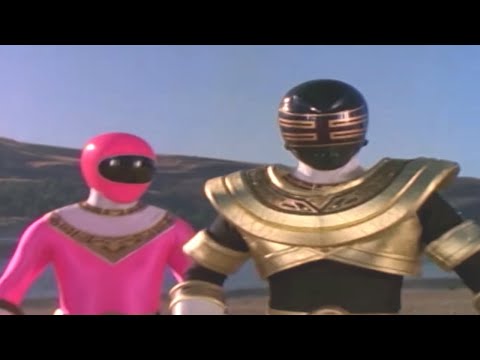
Jason cannot safely retain the Gold Ranger powers because they are harming his human body. In Good as Gold, the team learns that the powers are leaving him and taking his life force with them. Returning them to Trey becomes a rescue problem, not a vote on whether Jason deserves the suit.
That matters because the popular shorthand—“Jason wasn’t strong enough”—makes the story sound like a failed audition. Zeo is much more specific. Jason can use the powers and fight effectively. He cannot keep doing so indefinitely under the conditions the finale establishes.
Start with Trey, not Jason
The Gold Ranger identity belongs to Trey before Jason takes it on. In the official Revelations of Gold excerpt, Trey explains his nature as a Triforian and his loss of unity. Until he is whole again, he cannot use the Gold Ranger powers.
That creates the need for a transfer. It does not establish that Trey is handing over the identity permanently, or that the Gold powers have become a sixth ordinary piece of the Rangers’ Zeo Crystal.
The distinction is easy to lose because both power systems are operating in the same season. The story is about temporarily solving a problem with Trey’s powers, alongside the regular Zeo team.
What changes when Jason receives them
A Golden Homecoming makes Jason’s arrival a return to the group, not a replacement for Tommy as Red Ranger. Tommy remains Zeo Ranger V Red. Jason joins with the Gold powers.
That is one of the pleasures of the setup: the former leader can contribute without the series having to demote the current leader. Two familiar heroes occupy different jobs. A Gold suit is not a new election for team captain.
The transfer also gives the audience a temporary practical solution. Trey cannot wield the powers in his divided condition; Jason can take them into battle. At that point, the fact that the transfer works should not be mistaken for proof that it has no long-term cost.
The finale names the cost
In Good as Gold, the warning begins around 7:13 in the official upload. The conversation connects Jason’s deterioration to the Gold powers draining away. Later explanation identifies the strain on a human form and the need to get the powers back to Trey.
The characters respond by trying to restore the circumstances that will let Trey receive them. This is why “just let Jason keep them” is not a small change. It would leave the finale’s central danger unresolved.
| What the story establishes | What it does not establish |
|---|---|
| Jason has successfully fought as the Gold Ranger. | That successful battles guarantee permanent compatibility. |
| Keeping the powers is now endangering him. | That he is cowardly, unworthy or a poor Ranger. |
| Trey needs to be reunited to wield them again. | That any available person could accept them without consequences. |
| The powers return to Trey. | A numerical ranking proving Gold is stronger than every other Ranger power. |
Why the limitation is useful storytelling
Our interpretation: Jason’s return would be flatter if it simply awarded an old favourite a stronger suit forever. The limit asks a more interesting question: can a heroic return still count if it has an ending?
Here, it does. His contribution does not disappear when the powers leave him. The character’s courage, experience and relationships were never stored entirely in the staff. Giving up an ability that is killing him is a sensible outcome, not a humiliation.
It also protects the idea that different powers have different rules. The franchise has borrowed powers, damaged powers, replaced powers and powers with conditions attached. Treating all of them as interchangeable coloured batteries erases the stories built around those differences.
The honest starting point for a What If
A story called What If Jason Kept the Gold Ranger Powers? needs to change the compatibility problem explicitly. It could invent a stabilising mechanism, alter the transfer, or make the continuing danger the plot. None of those solutions is automatically supplied by the original episode.
What it should not do is quietly declare that Jason could have solved the problem by wanting it more. That substitutes motivational advice for the actual obstacle. Even in Power Rangers, “have you tried being more determined?” is not a universal repair manual.
Three scenes to revisit
Watch Trey’s explanation in Revelations of Gold, Jason’s transfer in A Golden Homecoming, and the warning and resolution in Good as Gold. Together they answer the full question: why the vacancy exists, why Jason can fill it, and why that solution cannot safely last.
Next: The different losses and replacements of Ranger powers, or our explicitly fictional original-team Zeo scenario.
Sources and further viewing
Spotted a detail we should check? Send a correction with the source. Our editorial approach.